
Review · VIKING EXPERIENCES
Oslo Viking Quest: Exploration Game and Tour
A puzzle map is a different kind of sightseeing. This Oslo Viking Quest turns the center of the city into a moving scavenger hunt, with 11 interactive challenges that teach you what you are looking at. I like that it hits big sights such as the Royal Palace and Oslo City Hall while still letting you explore at your own speed. One thing to plan for, some hints can be tricky to decode, and bad weather makes the walking and searching less fun.
The format is simple. You get a mobile access code, then start the game whenever you want. If you need a break, you can pause and resume, so you are not stuck with a rigid tour schedule.
Value matters too, and this one stays friendly on price at about $7.20 per person. It is only about 1 hour 15 minutes on paper, but the game invites side stops, so budget extra time if you want to linger.
In This Review
- Key points before you go
- How this Oslo Viking Quest actually works
- The big value play: price, pace, and puzzle-based learning
- Start at Rådhusgata 30B, play your way to Akershus
- Nobel Peace Center challenge: politics meets peace history
- Oslo City Hall puzzle: why the building matters
- Nils Sigurd Aas statue stop: art you can spot fast
- Royal Palace challenge: a residence with big political meaning
- University of Oslo stop: a timeline you can walk through
- Storting building puzzle: Norway’s parliament in plain view
- Oslo Cathedral challenge: history you can feel in the stones
- Norway’s Resistance Museum at Akershus Fortress: war history with weight
- Akershus Fortress setting: a medieval backbone for the city
- What to expect from the puzzle challenges (and what can annoy you)
- Best fit: who will love this and who might not
- Practical tips to get the best Oslo experience
- Should you book the Oslo Viking Quest?
- FAQ
- How much does the Oslo Viking Quest cost?
- How long is the experience?
- Can I choose when to start the game?
- Is it available in English?
- What is included in the quest?
- Do I get a physical guide?
- Where does the quest start and end?
- Are there restrictions on participants?
- What is the cancellation policy?
Key points before you go
- Start whenever you want, with no fixed itinerary, which is great for lining up with your other plans
- 11 puzzle challenges that keep you moving and paying attention to Oslo’s landmarks
- Top sights in central Oslo, including Oslo City Hall, the Royal Palace, and Oslo Cathedral
- Pause and resume anytime, so you can manage photo stops and cafés
- Private activity for your group, so the experience stays calm instead of crowd-y
- English is available, which makes the history content easier to follow in one go
How this Oslo Viking Quest actually works
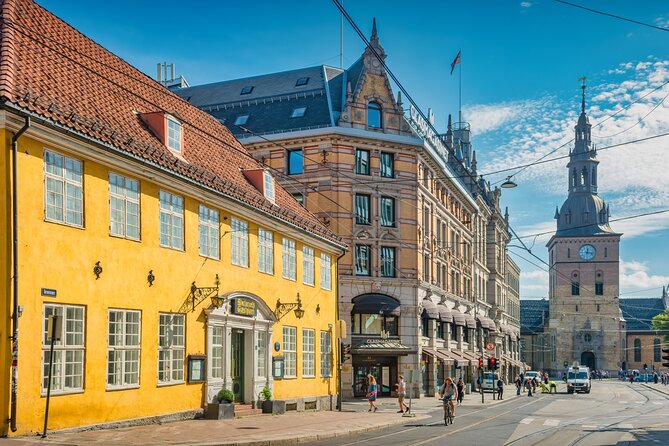
This is not a traditional guided walking tour. It is an exploration game built for you to play as you move through central Oslo and down toward Akershus Fortress. You get a mobile access code, and the quest guides you from place to place using challenges that ask you to look around and find answers.
That format is the key to why this works so well. When you are solving puzzles, you naturally slow down. You notice details that most people miss because they are just passing through. The best part is that you can control the tempo. If a stop turns out to be more interesting than expected, you have the freedom to take your time.
The tour is designed for about 1 hour 15 minutes. In real life, that is often just the core route. If you are the type to wander for a view, go inside a building when it is open, or take detours for photos, you can easily stretch it. That is not a bad thing. It is how the game nudges you to see more than the headline landmarks.
Also, it is English, and the experience is described as suitable for most travelers. Service animals are allowed, which helps if you travel with one.
More Viking Experiences in Oslo:
- Oslo: Viking Planet Entry Ticket
★ 4.4 · 603 reviews - The Viking Planet Museum Ticket
★ 4.0 · 197 reviews - The Viking Planet Museum – Mini Group (4 adults)
★ 4.0 · 16 reviews
The big value play: price, pace, and puzzle-based learning
At about $7.20 per person, the cost is the first thing that catches your eye. But the smarter question is what you get for it. You are paying for a structured way to learn without paying for a full-time guide, and you get a clear set of stops tied to the story of Oslo.
You also get something that many walking tours do not deliver well: “look at this, then figure out why it matters.” The challenges force you to pay attention to signage, statues, and key architectural choices instead of just reading a sign at the speed of boredom.
If you want a quick way to get oriented in central Oslo, this kind of game has real value. It is especially good the day you land, or any time you want to break up sightseeing with something active. If you prefer passive sightseeing, though, the “search and answer” part may feel more like work than fun.
Start at Rådhusgata 30B, play your way to Akershus
The quest begins at Rådhusgata 30B, 0151 Oslo. That is a central pick-up area, and it sets you up close to the city’s main civic sights. Your end point is at the Scandinavian Star Memorial at Akershusstranda, 0150 Oslo.
Opening hours are listed from 5:00 AM to 9:00 PM, Monday through Sunday. Since the game says you can start when you want, you can usually fit it into a half-day plan, then connect the last stretch to whatever you are doing near the harbor and fortress area.
Practical tip: if you are pairing this with other activities, think of it as a flexible route. You do not need to rush through any stop, but you also cannot forget you are still walking between locations.
Nobel Peace Center challenge: politics meets peace history
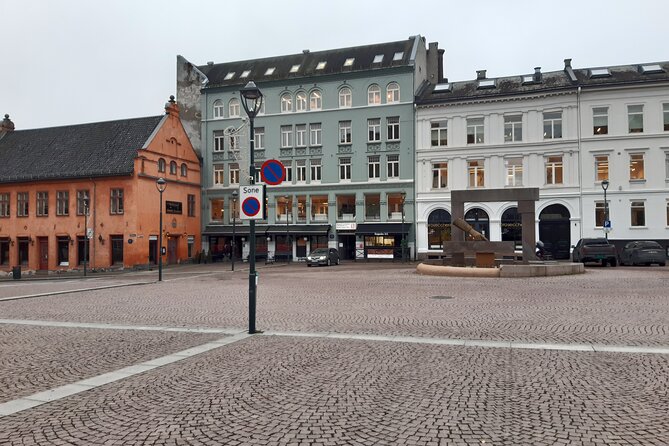
One of the early stops is the Nobel Peace Center. This place is designed as a showcase for the Nobel Peace Prize and the ideals behind it. It is also a kind of forum space where culture and politics meet, with themes like war, peace, and conflict resolution.
In the game, you are not just looking. You have to scan the area and answer a challenge to move to the next location. That turns the center into a “find the clue” experience, which is a strong way to keep your attention while you take in the bigger ideas the building represents.
What to watch for here: take a slow loop before you hunt for the specific answer. If you go straight to the challenge without getting the context, you can miss the message the place is trying to communicate.
Weather note: this stop involves looking around outside and inside depending on what you do. If you are visiting in cold or wet conditions, having a bit of patience helps because searching can take longer.
A few more Oslo days worth weighing up
- Oslo: Oslo Fjord Sightseeing Cruise by Sailing Ship
★ 4.5 · 5,790 reviews - Oslo: Scenic Fjord Cruise with Audio Guide Commentary
★ 4.5 · 5,375 reviews - Oslo Nature Walks: Island Hopping Tour
★ 4.8 · 2,713 reviews - Oslo: 24 or 48-Hour Hop-On Hop-Off Sightseeing Bus GrayLine
★ 4.0 · 2,088 reviews
Oslo City Hall puzzle: why the building matters

Next up is Oslo City Hall. It is the municipal building that houses the city council and other city administration offices. The structure you see today was built between 1931 and 1950, with an interruption during the Second World War.
The game challenges you to look around and find what you need to answer. That makes the history feel less abstract. Instead of reading a short description and moving on, you are actively connecting the building to the story of its time and its role in Oslo life.
Practical angle: City Hall is one of those landmarks where architecture tells you a lot. Even when you do not consider yourself an architecture fan, the puzzle format helps you notice shapes, materials, and prominent features that you would otherwise skip.
Nils Sigurd Aas statue stop: art you can spot fast
The quest then takes you to Nils Sigurd Aas, a Norwegian sculptor known for modern Norwegian sculpture. He is especially well known for his statue of Haakon VII in June Seventh Square in Oslo. He also designed coins for Norwegian currency, including the 10-krone and 20-krone coins.
This stop works because it links art with everyday life. Coins are something you carry, and a statue is something you see and orient yourself with. The game has you look around again to find the answer, so you get a quick education on the person behind the public art.
Tip: if you love quirky facts, this is the kind of stop that makes the whole quest feel fun instead of purely educational. You come away remembering a name, a statue, and a detail about currency.
Royal Palace challenge: a residence with big political meaning
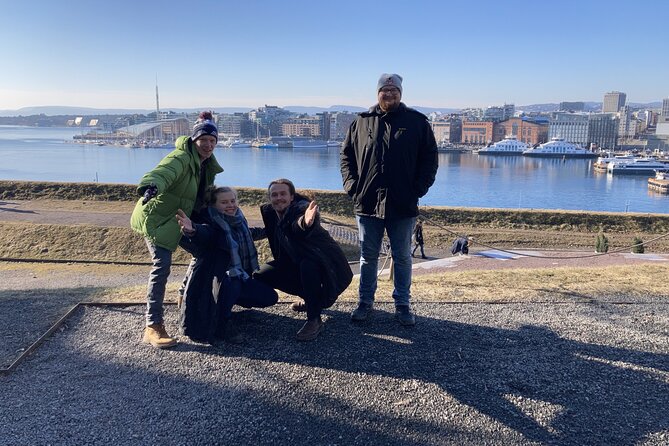
The Royal Palace in Oslo is next. The game’s story frames it as the Norwegian residence of King Charles III John of Norway, who was French-born and reigned as king of Norway and Sweden. The palace was built in the first half of the 19th century.
This is a major landmark, and the game helps you focus on what to look for. You search around to solve the challenge and move onward, turning a “photo stop” into a more thoughtful visit.
If you want to make this stop better for yourself, give it an extra few minutes. Let your eyes adjust to the scale. Then take your puzzle answer, and only after that go for photos.
University of Oslo stop: a timeline you can walk through
You also pass by the University of Oslo. Until 1939, it was known as the Royal Frederick University. The game uses this stop to reinforce Oslo’s deeper roots as a city of institutions, learning, and long-term influence.
Again, the mechanism is search and answer. That keeps you engaged, but it also gives you a simple way to connect a university with national history rather than treating it as just another campus building.
In practice, this stop is good if you want variety. After palaces and government structures, seeing education represented in the route adds a different angle.
Storting building puzzle: Norway’s parliament in plain view
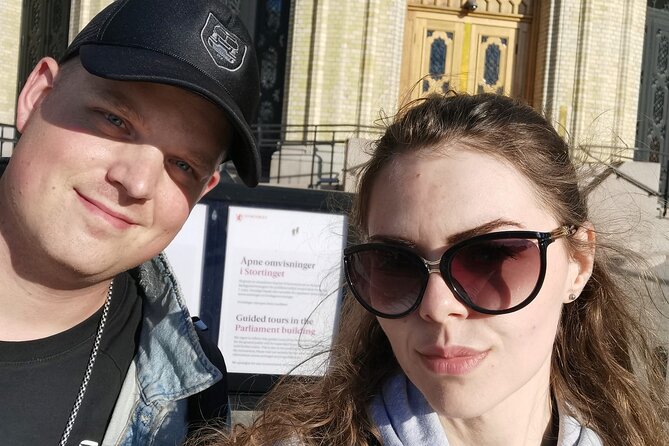
The quest continues to the Storting building, the seat of the Norwegian parliament. It is located at 22 Karl Johans gate and was taken into use on 5 March 1866. The building was designed by Swedish architect Emil Victor Langlet.
This stop is valuable because it anchors your understanding of how power and public life are physically represented in Oslo. The puzzle asks you to look around and find the answer, so you are forced to pay attention instead of just walking by.
Tip for making this efficient: keep your phone screen handy while you approach the building, but still look up first. A lot of answers are easier to spot once you understand what part of the building the challenge is pointing you toward.
Oslo Cathedral challenge: history you can feel in the stones
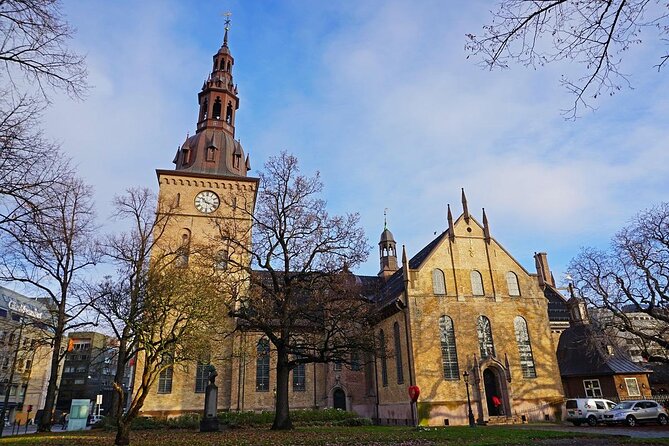
Next is Oslo Cathedral, formerly Our Savior’s Church. It is the main church for the Church of Norway Diocese of Oslo and the parish church for downtown Oslo. The current building dates from 1694 to 1697. The Norwegian Royal Family and the Norwegian Government use the cathedral for public events.
The game turns this into a “look carefully” stop. You are searching for an answer, which naturally makes you pay attention to features and historical cues.
This stop is a good reminder that Oslo is not only civic buildings and modern museums. It also has layers of old religious and governmental life.
If you are visiting when events or access limitations apply, you might need a little flexibility in how quickly you move through. The game’s pause and resume option can help you manage that without stress.
Norway’s Resistance Museum at Akershus Fortress: war history with weight
Finally, you reach Norway’s Resistance Museum, also known as the Norwegian Home Front Museum, located at Akershus Fortress. The collection focuses on Norwegian resistance during the German occupation from 1940 to 1945. You can expect equipment, photos, and documents from the war years.
This is the kind of stop that can slow you down in a good way. The game still uses the puzzle format, asking you to look around to learn the story of the place and advance to the next location.
Even if you do not spend a long time reading everything, the structure of the quest helps you understand why this fortress area matters. It shifts the tone from royal and civic Oslo into a more serious chapter of Norwegian history.
Akershus Fortress setting: a medieval backbone for the city
The quest’s final anchor is Akershus Fortress itself. It is described as a medieval castle built to protect the city and provide a royal residence. That means you get a sense of how Oslo’s central defense and rule were once fused in one stronghold.
Your end point is near the area of the Scandinavian Star Memorial at Akershusstranda. That location makes sense as a finish line because Akershus is not only about walls. It is also about memory and the way modern Oslo uses historic space.
If you want a smooth finish: take a last look around before you end. The fortress area rewards a slow wander, even if the game itself has already guided you through the main clues.
What to expect from the puzzle challenges (and what can annoy you)
The quest includes 11 interactive puzzle challenges. Each one is designed to get you looking around at the right spot, then moving you along.
This is great when you like being active. It also helps if you get bored easily on walking tours. You are not just staring at buildings. You are solving something.
The downside is hinted in a less-than-perfect rating you should take seriously. Some hints can be hard to understand, and if you are visiting in rain or extreme cold, the time you spend searching can feel longer than you planned.
My advice: bring warm layers if the weather is nasty. Also, do not be afraid to pause, regroup, and continue. The game lets you pause and resume anytime, which is a big deal if you are stuck on a tricky clue.
Best fit: who will love this and who might not
I think this Oslo Viking Quest is ideal if you want a low-effort, fun way to learn central Oslo. It fits well for solo travelers who like puzzles, couples who want an activity with shared payoff, and families who can handle the game pace.
It also makes sense for visitors who have limited time and want to see the major highlights in a connected route. The stops cover the Royal Palace, City Hall, the cathedral area, Storting, and the Akershus historical zone, so you are not piecing together everything yourself.
If you hate walking or you prefer a guide to explain everything in a clear narrative from the start, this might feel less satisfying. The quest is built on your ability to look and solve.
Practical tips to get the best Oslo experience
- Plan for extra time if you like side exploring. The core route may be short, but Oslo is made for detours.
- Use the pause and resume feature when you hit museum queues or need a café break. It keeps the game enjoyable.
- If you are cold or wet, lean into the puzzle mindset. Searching faster is easier when you feel comfortable.
- Take photos after you solve the clue. You will appreciate the details more once you know what you are looking for.
Should you book the Oslo Viking Quest?
Book it if you want a cost-effective way to see central Oslo through puzzles, landmarks, and short history moments. At about $7.20 per person, you get a structured route with a flexible start and the freedom to linger where you care. It is also a good “first visit” option because it hits multiple iconic civic and royal sites plus a heavier historical ending at Akershus.
Skip it if you mainly want someone to talk at you for the whole time, or if you know you will struggle in messy weather with outdoor searching. The game depends on attention, so bring patience if you expect a clue to be unclear.
If you are open-minded and you like the idea of learning by looking, this is a smart way to turn a simple walk into a real Oslo story.
FAQ
How much does the Oslo Viking Quest cost?
The price is listed as about $7.20 per person.
How long is the experience?
It is approximately 1 hour 15 minutes.
Can I choose when to start the game?
Yes. The experience says you can start the game when you want, with no fixed itinerary.
Is it available in English?
Yes, the experience is offered in English.
What is included in the quest?
It includes a mobile access code for the quest, 11 interactive puzzle challenges, immersive Viking storyline and Oslo history content, and the ability to pause and resume anytime.
Do I get a physical guide?
No. It is a private activity where your group participates, and a physical tour guide is not included.
Where does the quest start and end?
It starts at Rådhusgata 30B, 0151 Oslo, Norway. It ends at the Scandinavian Star Memorial at Akershusstranda, 0150 Oslo, Norway.
Are there restrictions on participants?
The experience says most travelers can participate, and service animals are allowed.
What is the cancellation policy?
You can cancel for free up to 24 hours in advance for a full refund. Cancellation within 24 hours does not receive a refund, based on the local time of the experience.
Recently added around Oslo
- 4 hours Best View of the Oslofjord Winter Edition★ 4.0 · 15 reviews
- Oslo Winter Highlights Bike Tour★ 5.0 · 36 reviews
- Winter Forest Walk and Campfire by Torchlight in Oslo★ 4.5 · 20 reviews
- Viking Planet Oslo Combination Ticket (Museum +VR Game)★ 4.0 · 13 reviews
- Unknown war. Oslo and Norway during 1940-45★ 5.0 · 74 reviews
- The Ultimate Norwegian Skiing Experience★ 5.0 · 16 reviews
- The Viking Planet Museum – Mini Group (4 adults)★ 4.0 · 16 reviews
- The Ultimate Study of the Human Form at Vigeland’s Sculpture Park with a Local★ 4.0 · 14 reviews
Viking Experiences, compared.

Viking Village, Nærøyfjord Cruise & Flåm Railway
Read our review →
Guided tour – Viking Village, Nærøyfjord Cruise and Flåm Railway
Read our review →
Viking Village, Nærøyfjorden Cruise and Flåm Railway
Read our review →
Bergen Fjord Experience Aboard Viking-style Ship
Read our review →
Guided E-Bike Tour in Haugesund: city, vikings, Rising Tides
Read our review →
Haugesund Viking Cruise – The Viking Farm and Viking Planet
Read our review →
Winter Tour Viking Village, Nærøyfjord Cruise & Flåm Railway
Read our review →
Browse the lists this tour appears in